
The Story of Nuh and the Ark
A story of patience, warning, trust in Allah and rescue after a great flood.
Jump to a chapter (optional)
1 The prophet’s patient call
Prophet Nuh spent a very long time calling his people to worship Allah alone. He spoke kindly, warned clearly and continued day after day. Some people listened, but many turned away. They laughed at him and refused to change.

Nuh called his people in many different ways: publicly and privately, by day and by night. He reminded them of Allah’s mercy and of the blessings they could see in rain, gardens and life itself. Yet most refused, and influential people dismissed the believers as unimportant. Nuh’s task was not to impress the powerful but to deliver Allah’s message faithfully.
Nuh (AS) spoke to his people over a long period, both privately and publicly. He invited them to seek Allah’s forgiveness and notice His gifts, including rain and growing things. Yet many refused to listen and preferred familiar customs. Nuh’s patient call reminds us that a prophet’s duty is to convey the truth faithfully, even when people do not immediately accept it (Qur’an 71:1–20).
2 The ark, the flood and a difficult choice
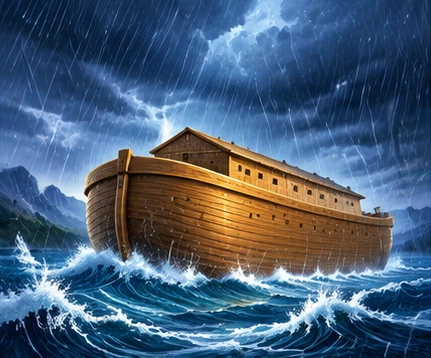
The Qur’an describes Allah instructing Nuh to build the ark under divine guidance. As it took shape, his opponents continued to mock him. When Allah’s command came, the flood began, and those entrusted to the ark were brought aboard. The image of the great vessel is memorable, but it is not the main lesson: obedience to Allah remained important even when the crowd believed otherwise.

Allah told Nuh that a flood would come and that he should build an ark. Imagine how surprising this must have sounded. Yet Nuh trusted Allah completely. He began building the ark even while people mocked him. They saw wood and tools, but he saw Allah’s promise.
When the time came, the believers came near the ark. Animals were gathered in pairs, and the ark became a place of safety by Allah’s permission. Rain fell, water rose and the flood began. What had seemed impossible now became real.
One of the saddest parts of the Qur’anic account concerns a son of Nuh who did not board the ark. Nuh called to him with the care of a father, but the son believed a mountain could save him from the water. It could not. Allah taught Nuh that belonging to a prophet’s family does not replace faith and righteous action. We can speak about this gently with older children, remembering how painful the separation was.
Allah commanded Nuh (AS) to build the ark. The Qur’an reports that his people mocked him as he worked. When the flood arrived, the believers were protected by Allah. Nuh called to a son who did not board, and the account teaches that family connection alone does not replace personal faith and responsibility (Qur’an 11:36–46).
3 After the flood
The ark moved across the waters while the believers remained under Allah’s care. Eventually the flood ended, the danger passed and those in the ark were saved. The Qur’an presents this as a sign: Allah helps His servants who believe, obey and remain patient.

After the flood, Allah commanded the waters to subside and the ark came to rest. Nuh and the believers emerged into a changed world. Their survival was not a reward for having possessions or social status. It was a sign of Allah’s mercy and of the seriousness of the message they had heard.
For younger children, tell the story without frightening descriptions of suffering. For preteens, the difficult family moment raises a thoughtful question: how do we keep doing what is right while still caring for people who make different choices? Nuh’s example combines unwavering faith with heartfelt concern.
When the flood subsided, the ark came to rest. The story continues with Allah’s instruction to Nuh and those with him. Children can learn about perseverance without needing graphic descriptions of disaster; older readers may explore the difficult family episode more carefully (Qur’an 11:44–49).
What can we learn?
Big idea: A believer keeps doing what is right even when others laugh, ignore or delay. Allah sees patient effort.
Talk about the story
- What did Prophet Nuh keep doing even when people laughed at him?
- Why did Nuh continue building the ark?
- What lesson can children learn when they are trying to do what is right?
Additional family reflections from the earlier edition
Even though this was hard, Nuh did not stop doing his duty. He was a prophet, and he cared about the people around him. He wanted them to be safe in this life and the next. His story teaches us that success is not always about quick results. Sometimes success means staying patient and faithful over a long time.
Children can learn something powerful from Nuh. If you are trying to tell the truth, pray on time, be kind or do what is right, some people may not understand you straight away. That does not mean you should give up. Nuh teaches steady faith.
When we hear the story of the ark, we should remember more than the animals and the rain. We should remember the patient heart of a prophet who trusted Allah even when others laughed. Trusting Allah does not make every path easy, but it gives every step meaning.
Talk together: What is one good habit that takes patience, even if other people do not notice it straight away?
Check your understanding
Answer three questions about the story, then review the explanations.
Sources and further reading
How to read these sources: Qur’anic verses are the primary text. Explanations about prophetic infallibility and other doctrines follow Twelver Shia interpretation. The child-friendly dialogue and reflections are adaptations, not quotations from scripture or hadith.
Chapter-by-chapter Qur’an guide
Read the linked Qur’anic passages for the events described. Some chapters draw on more than one passage; the links are starting points for reading the scripture, not independent authentication of every sentence in this educational retelling.
The Qur’an is the primary source for the narrative. This is an age-appropriate retelling from a Twelver Shia perspective, not a word-for-word translation or a complete tafsir. Some explanatory transitions are editorial summaries. Historical and theological details that go beyond the cited passages should be checked against qualified Shia scholarship.
How we check historical and religious content
Twelver Shia editorial note: The account of a son not boarding the ark is Qur’anic (11:42–46); it is not necessary to speculate about the child’s name, age or private thoughts.
References identify where to study the passages. Translation choices, interpretations and historical additions remain subject to qualified review.
Evidence labels: Qur’an = primary scripture; Twelver Shia interpretation = theological reading; narrative transitions = educational paraphrase. Qur’anic verses are cross-referenced here, but the prose and any extra-Qur’anic details still need a qualified scholarly review.